
Japan luggage forwarding and coin lockers solve different problems. Forwarding moves your suitcase to another destination; a locker keeps it in one place until you collect it.
If you need your bag later today, start with storage. If you can do without it until a confirmed delivery date, consider forwarding.
Dragging a suitcase through a crowded station is one of those travel problems that seems small—until you are standing at the bottom of a staircase with a train leaving in four minutes.
The useful question is not which service is best, but which one fits the next part of your trip.
Below, compare the costs, delivery and collection checks, and five itinerary examples—including Tokyo to Kyoto, an overnight stop in Hakone, and sightseeing after hotel check-out.
You may also find that keeping a small bag with you is the simplest choice.
01 — Quick answer: choose by itinerary
Send your suitcase ahead if you will not need it until a later hotel stay and the carrier confirms a delivery schedule that works for you. Keep enough essentials with you until it arrives.
Choose a coin locker or short-term storage if you need the bag again later today. Pick somewhere you can collect it without an awkward detour before your train or hotel check-in.
Keep it with you if you need frequent access, or if the bag is small and your route is straightforward. There is no need to book anything just because luggage services are available.
Next, check the practical detail that could upset the plan: delivery time for forwarding, collection time for storage, or how easily you can manage the bag yourself.
At a glance
| Option | Best when | Access to bag | Rough cost |
| Luggage forwarding | Next hotel / overnight detour; delivery timing fits | No, while in transit | Example: ¥2,780 (140) / ¥3,160 (160), Kanto→Kansai |
| Coin locker | Same-day storage / returning to the same area | When you return | Prices vary by station and size. Some lockers cost around ¥500 (small), ¥700 (medium), and ¥900 (large) |
| Carry it yourself | Small bag / simple route | Always | ¥0 |
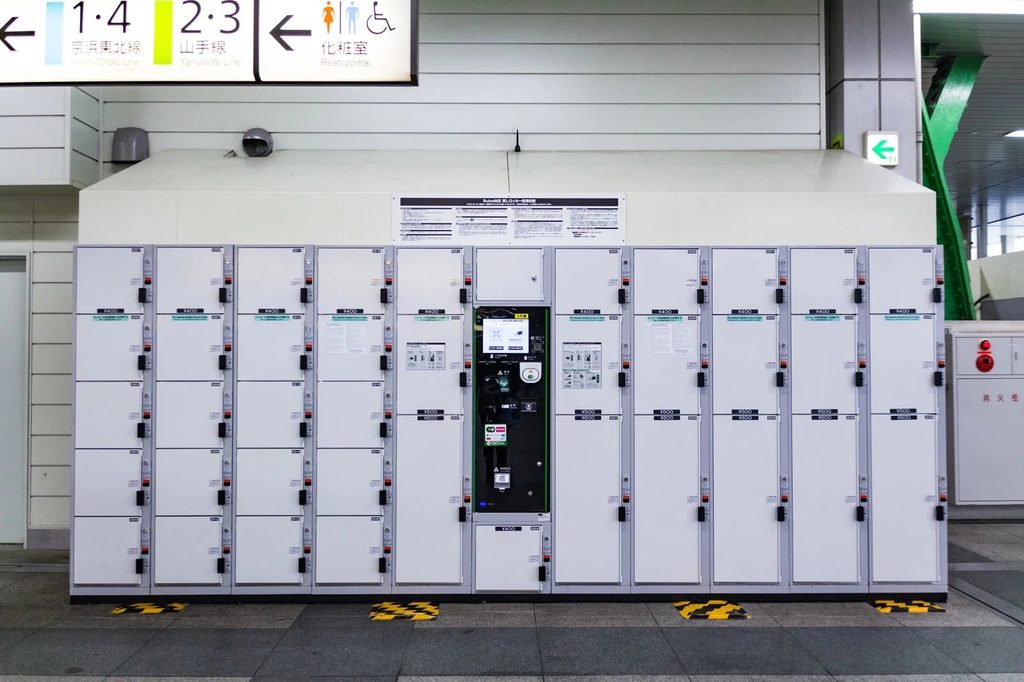
Coin lockers at a Japanese station offer short-term storage in several sizes.
02 — When luggage forwarding is the better choice
Forwarding can take a large suitcase out of the part of your trip that involves stairs, crowded platforms, and several transfers.
Start with a familiar example: Tokyo hotel → Kyoto hotel. If you can manage without your suitcase until its confirmed delivery window, ask your Tokyo hotel whether it can arrange shipment and your Kyoto hotel whether it will accept the bag. If you need it that evening and arrival is not confirmed, keep it with you instead.
An overnight stop can make forwarding even more useful:
Tokyo → one night in Hakone, a popular hot-spring stop near Tokyo → Kyoto
You could send the large suitcase from Tokyo to Kyoto and take a small overnight bag to Hakone. Check the delivery date first, then pack enough clothing and toiletries to cover the time until your suitcase arrives.
Before handing it over, confirm the destination address, your booking name and check-in date, and when someone can receive it.
When sending luggage to a hotel or ryokan with Yamato Transport, confirm in advance that the accommodation agrees to receive it. Yamato’s hotel-delivery guidance says to send the luggage before the local cut-off time at least two days before check-in; depending on the distance, three days may be necessary. Check the applicable sending deadline and expected delivery date with Yamato, and confirm receipt and collection arrangements with your accommodation. Do not assume next-day delivery or a specific delivery time.
Keep your passport, valuables, medication, and anything you need on the journey with you, and save the shipment receipt or tracking details.
For a rough cost reference, Yamato Transport’s current published cash rates from the Kanto region to Kansai are ¥2,780 for size 140 and ¥3,160 for size 160. Actual costs can differ depending on the counter, hotel service, route, and any additional handling conditions. Size 140 and 160 refer to a maximum length + width + height of 140 or 160 cm, with weight limits of 20 or 25 kg respectively; exceeding either limit can move the bag into a higher size category.
Disclosure: This article contains affiliate links. If you book through them, Rambling Japan may earn a commission. We only include services when they fit the travel situation described.
If your trip is within Tokyo, or between a Tokyo hotel and Narita or Haneda Airport, the Klook service below is one option to check. This specific product is for supported Tokyo-area routes; it is not the Tokyo → Kyoto forwarding service described above.
Check supported Tokyo luggage delivery routes on Klook
Before booking, select your exact route and check hotel coverage, drop-off deadlines, the delivery or collection window, accepted bag sizes, and the total price. For an airport transfer, the bag must be available early enough for your flight check-in—not simply arrive sometime on the same day.
An unattended apartment needs a different plan. Yamato’s traveler guidance says its pickup and delivery services are not available at Airbnb-style properties without reception staff. Ask the carrier about an eligible pickup point, or carry the bag between accommodations and use storage during sightseeing. Do not send it to an unmanned address on the assumption that someone will accept it.
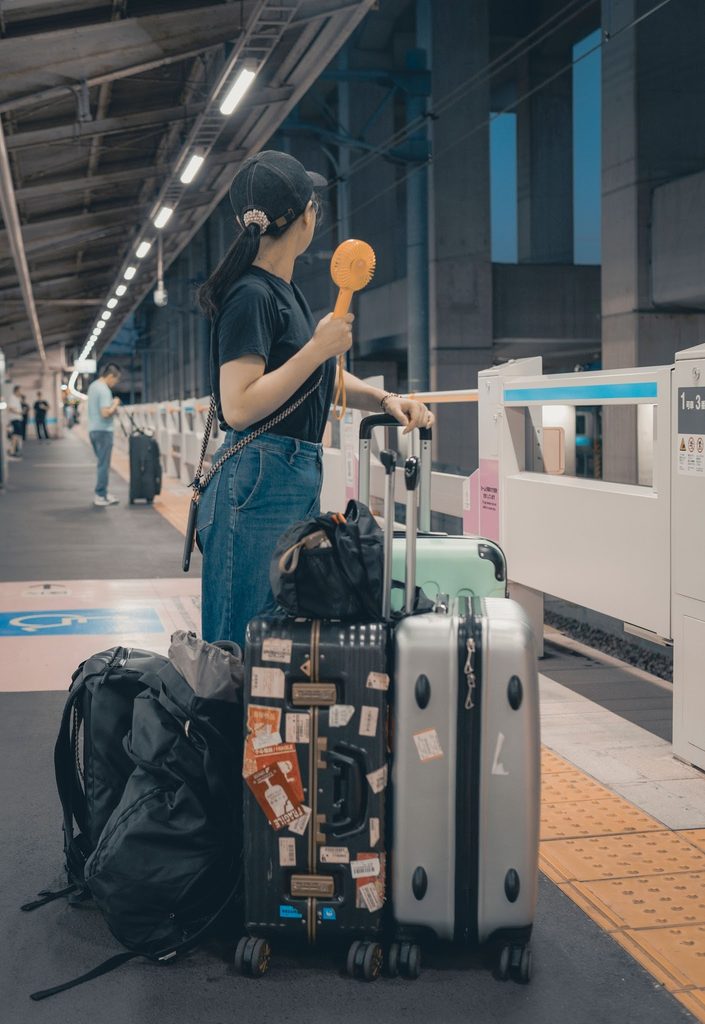
Traveling through a Japanese station with luggage can make transfers more cumbersome.
03 — Coin lockers in Japan: prices, bag size and collection time
If you have checked out but still have a few hours to explore, a locker can be an easy way to get your hands back.
Many stations and transport hubs have coin lockers, with accepted payment methods depending on the locker. Prices and charging rules vary by operator, location and locker size. For a specific example, JR East Smart Logistics’ March 4, 2026 announcement for MULTIECUBE lockers at Kansai International Airport listed ¥500 for small, ¥700 for medium and ¥900 for large units, with other sizes also available. It listed a separate ¥500 advance-reservation fee and an additional daily storage charge when use continues past 2:00 a.m. into the next day. These are the published terms for that example, not nationwide rules or a guarantee of today’s price. Check the posted price, internal dimensions, access hours, payment options and daily charging boundary at your chosen locker.
An empty locker is useful only if your bag fits and you can return in time. Large units may already be occupied, so leave a little time to find another option rather than making storage the last task before your train.
A locker is a good fit when:
- you will return to the same station or nearby area;
- you need the bag again later that day;
- the bag fits and you can collect it within the access hours; and
- you have a backup if the right locker is unavailable.
If collecting the bag would mean crossing the city again, look for storage near your onward departure point—or keep the bag with you if that is simpler.
04 — Five real itinerary examples
1. Tokyo hotel → Kyoto hotel
Best fit: forwarding if the delivery schedule works.
Confirm the arrival window before sending. You can then travel with a smaller bag; if you need the suitcase before delivery, carrying it is the safer plan.
2. Check out in Shinjuku at 10 a.m. → evening train from Shinjuku
Best fit: coin locker or nearby storage.
First ask whether your hotel can hold it after check-out, especially if you will pass that way again. Otherwise, a locker or nearby storage keeps collection close to your evening departure.
3. Tokyo → one night in Hakone → Kyoto
Best fit: luggage forwarding plus a small overnight bag.
Arrange delivery to match your Kyoto stay, then pack for Hakone and any extra time before the suitcase arrives. This saves hauling a large bag through the overnight stop.
4. Day trip from Tokyo with one carry-on
Best fit: carry it, unless it would get in the way.
A small bag on a simple route may be easier to keep with you. Use a locker only if the time without it would be worth the fee and collection stop.
5. Self-check-in apartment → another self-check-in apartment
Best fit: carry it unless an eligible receiving point is confirmed.
Storage can free you up for sightseeing, but it does not move the suitcase to the next apartment. You still need a workable collection and onward-transport plan.
05 — Lockers full or suitcase too big? Other luggage storage options
A locker is no help if it is full or your suitcase will not fit.
First, check another locker area or a staffed baggage counter at the station. You can also ask your hotel whether it can hold your bag before check-in or after check-out. If either fits your route, you may not need a separate booking.
Before leaving your bag, confirm when you must collect it and whether you will need a train ticket to reach the storage area again.
If those options do not work, compare a bookable luggage storage location near the station you will actually depart from. A short walk on arrival can become an inconvenient detour when you return for your suitcase.
Bounce is one option to check when you want to reserve storage rather than search for an empty locker.
Enter your location and dates, then compare the available drop-off and collection times, accepted bag type, walking route and total booking price. Availability and conditions depend on the selected location.
Affiliate disclosure: If you book through this Bounce link, Rambling Japan may earn a commission.
Check Bounce storage locations and total prices
Book only after confirming that the location accepts your bag and will be open when you return.
If a suitable locker or hotel storage is more convenient and costs less, use that instead. A reservation is useful when it solves your particular problem; it is not automatically better than a locker.
06 — When carrying it yourself is simpler
Sometimes the easiest luggage plan is to keep the bag and get on with your trip.
One small suitcase, a direct train, a manageable route, and little time between check-out and check-in may not justify delivery paperwork or an extra storage stop. Consider your own mobility and energy, too: a route that looks short on a map may still feel difficult with a heavy bag.
If you will need things from the suitcase throughout the day, forwarding may create more problems than it solves. Storage can still help for a sightseeing break, but only if collecting the bag works with your plans.
You do not need a paid service when carrying the bag already works for you.
07 — One Shinkansen luggage rule worth knowing
On the Tokaido, Sanyo, Kyushu, and Nishi-Kyushu Shinkansen, a suitcase whose length + width + height is over 160 cm and no more than 250 cm requires a seat reservation with an oversized-baggage area. Measure the outside of the bag, including protruding handles and wheels. For example, a suitcase measuring 80 cm × 50 cm × 35 cm has a total of 80 + 50 + 35 = 165 cm, so it falls into this category.
There is no extra charge for reserving the designated oversized-baggage seat beyond the applicable reserved-seat fare. Bringing qualifying oversized baggage without the required reservation incurs a ¥1,000 baggage fee, and staff will direct you where to store it.
A total of exactly 160 cm or less does not require this oversized-baggage reservation, though you still need a suitable place for the bag. Bags over 250 cm in total cannot be brought on board. If your large suitcase qualifies, reserving the right seat may be all you need; forwarding is another option only if you can do without it until delivery.
Check the current JR Central oversized-baggage rules before you travel.
08 — Japan luggage forwarding and coin locker FAQ
Can luggage forwarding arrive the same day?
Only on eligible routes and within the service’s deadlines. Ask for the actual arrival or collection window: “same day” may still be too late for your hotel plans or flight.
For a city-to-city trip, do not send the bag on the assumption that it will arrive that evening.
Can I forward luggage to an Airbnb or self-check-in apartment?
Do not assume that you can. Yamato’s traveler guidance excludes properties without reception staff from pickup and delivery.
Other services have their own conditions. Confirm an eligible receiving arrangement with both the accommodation and carrier before paying or sending anything.
Are coin lockers always available at major stations?
No. Allow time to check another locker area or a staffed baggage counter, and confirm access hours for wherever you leave the bag.
If having a place reserved matters more than searching on arrival, compare a bookable storage location.
What if my suitcase does not fit in a coin locker?
Check a larger unit or a staffed baggage counter, then compare storage locations that explicitly accept your bag.
Confirm the size conditions, opening hours and total price before booking.
Forwarding is a different solution: it moves the bag elsewhere, so use it only if you will not need the suitcase before its confirmed arrival.
Which option is cheapest?
Carrying the bag has no added storage or delivery fee.
For a few hours without it, compare a suitable locker with any hotel storage available to you and the total quoted price of a booked location.
Forwarding serves a different need. Pay for it when avoiding the journey with a heavy bag is worth the cost and the delivery schedule works.
09 — The simple rule
Before booking anything, bring the decision back to your own plans:
When do I need this bag again?
Not until a later hotel stay → consider forwarding, after confirming arrival and receipt.
Later today → choose storage you can collect from in time.
Soon, or often during the day → keep it with you if you can manage it.
There is no prize for using an extra service. Choose the option that gives you a more comfortable day without creating a new problem at collection or delivery.
That is the side of everyday Japan Rambling Japan is interested in: not just what exists, but how people actually use it.